How to play

The Lord’s Handbook

The second half of the parchment book that opens the game: everything a new lord should know, from founding a city to the contest for the Royal City. Its numbers come straight from the game’s configuration.

Founding a City

When you first arrive, the golden rings on the map are the places suggested for you, all in the cradle provinces of the outer lands. Pick one and choose “Build here”: your capital and the ring around it — 7 tiles in all — are your first lands.

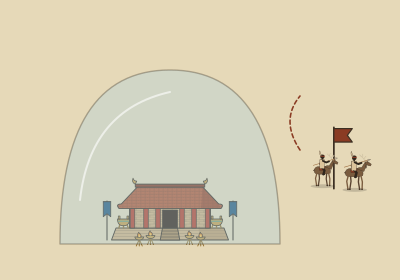
A new city has a 24-hour beginner's shield; while it lasts, no one can attack you. Use the time to raise your town hall and resource buildings and to train some troops.

You cannot build too close to another lord's capital, nor right next to a pass (keep at least 2 tiles away).

Claiming Land

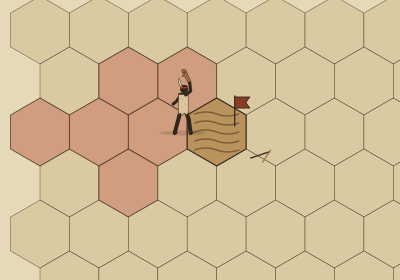
Your lands grow one tile at a time. Pick an empty tile next to your territory and send troops to claim it. Every wild tile has guards — more on richer deposits, and more still on passes. Win, and your troops stay to till the land; the tile is yours once the tilling is done.

Claiming costs resources, and the bigger your lands, the more it costs and the longer the tilling takes. How many tiles you can claim at once depends on your town hall.

Land cap: 15 tiles at the start, plus 5 for every town hall level. Beyond 15 tiles, every extra tile eats a little food each hour — more and more as you grow.

Tiles cut off from your capital stop producing. If someone cuts through your lands, reconnect them quickly.

Running Your Lands

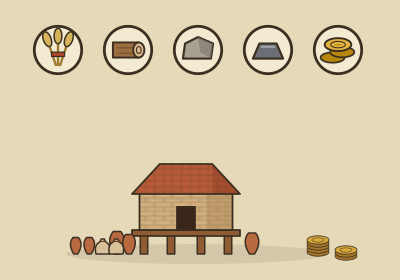
There are five resources in the Realm: food, wood, stone, iron and gold. Your capital produces some every hour, the deposits in your lands add more (5 per level per hour), and every level of farm, lumber mill, quarry or mine adds 15% to its resource.

Gold comes from taxes: 5 an hour from the capital, plus 0.25 an hour for every tile linked to it. Gold hires legends, and the market will take it too.

When the warehouse is full, the extra is simply lost — keep upgrading it. Spare resources can be traded at the market for what you lack, though the market gives only 1/3 of their worth.

Soldiers eat food, and the more you keep, the more each one eats.

Ages, Research and Policies

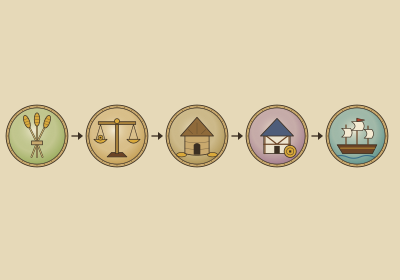
Each time the Grey Tide pulls back, sleeping knowledge wakes: the Bronze Age opens for everyone on day 7, the Iron Age opens for everyone on day 21, the Medieval Age arrives with the expansion “The Southern Ebb” on day 42, the Gunpowder Age opens for everyone on day 56.

Research in your academy. Finish the research that leads into a new age and you step into it: new troops to train, and buildings that can rise higher. Lords 2 or more ages behind the server build and research in 50% of the time and for 50% of the cost, so they can catch up.

Each age offers three policies; choose one and follow it — Stone Age: Farming, Hunting, Stockade; Bronze Age: Commerce, Martial spirit, Rites and music; Iron Age: Prosperity, Conquest, Bastion; Medieval Age: Manors, Levy, Stronghold; Gunpowder Age: Colonies, Artillery, Field Surgeons. Once chosen, it cannot be changed.

Armies

The barracks train infantry, the archery range ranged troops, the stable cavalry. The higher a building, the faster and the more of its troops it trains, and the harder they fight. Only one batch can be trained in the city at a time.

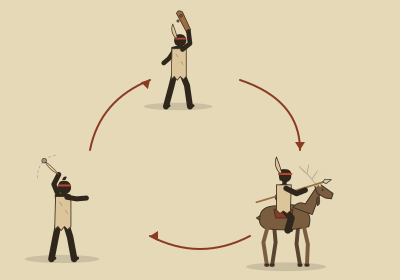
Infantry beat cavalry, cavalry beat ranged troops, and ranged troops beat infantry — the side with the edge strikes 30% harder.

Troops eat food, and the more you keep, the more each one eats. Running out of food starves no one, but it holds everything else back.

Peoples

Once your city stands, choose your people (“The Four Peoples…” at the top of the city panel): Highlanders (Stone production +10%, Iron production +10%, City defense +10%); Steppe Folk (Food production +10%, March speed +10%, Carry +15%); Forest Folk (Wood production +10%, 10% more of the storage is safe from raids (of the storage cap)); Tidefolk (Land tax +20% on every tile linked to the capital, 20% more from every market trade).

A people's bonuses always apply. The clan hall trains your people's unique troops, one for each age, finer than the common troops of the same kind: more attack, defense and life for about the same food, though they cost more and take longer to train, and the hall trains only half as many per batch as the barracks (25 per hall level). Each age's unique troop needs the clan hall at level 1, 3, 5, 7, 9; no research is needed. In battle, unique troops get the same bonus from the building that trains their kind (barracks, archery range or stable) and the same counters.

The first choice is free. Switching later costs 3000 gold, 2 times as much each time; you keep the unique troops you have, but cannot train more. Everyone can see which people you belong to; the old houses have peoples of their own, while the wild tribes and the Royal City's guards belong to none.

Marching to War

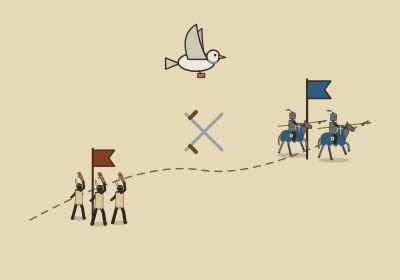
Pick another lord's city or tile to send troops: raid to plunder, occupy to take a tile, claim to settle the wild, or scout by sending a pigeon to see what is there. Distance depends on the terrain, and troops on the road can be recalled.

Battles are fought automatically by the server, and the result goes into a report you can replay round by round.

A raided lord gets an automatic 8-hour shield; 30% of the warehouse is safe from plunder; and the same lord can raid you successfully only once every 24 hours.

Passes and Tolls

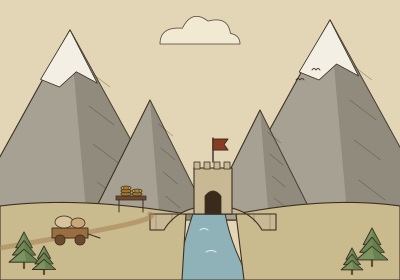
The only way from one province to the next is through a pass. Your armies cannot march through a pass another lord holds: go around, pay the toll if the holder has set one, or take the pass — its guards outnumber an ordinary tile's by 20.

Hold a pass and you set its toll: which resources and how much, or no passage at all. When a march would cross a toll, the march dialog lets you choose: pay and go through, or take the long way round.

Legends

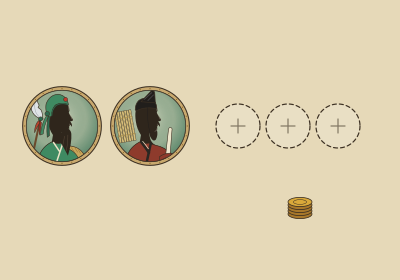
Generals add to attack and defense when they lead a march, and to the city's defense when they stay home; officials add to production. You start with one of each.

The legends do not all wake at once: when a world opens only 12 walk the Realm, and each new age the world reaches wakes a few more (4 in the Bronze Age, 8 in the Iron Age, 6 in the Medieval Age, 6 in the Gunpowder Age). Many also have a specialty: a general's counts only for the march they lead (faster marches, more plunder, weaker walls, fewer guards to fight), while an official's lasts as long as they serve you (faster building, research or training, more tax, better trades…).

Your town hall gains another seat at levels 3, 6, 9. Hiring a legend costs gold: 3000 for the first, and 2 times as much for each one after. The famous ones also want your renown to be high enough.

After beating a camp, an awakened legend sometimes offers to join you. Answer in the city panel: accept or decline. If every seat is taken, dismiss someone first.

Renown

Renown only ever rises, and everyone can see it. Each battle earns 5% of the strength of the enemy troops you destroy (defending your city and fighting guards when claiming count too); beating a camp earns more (by camp level: 20, 50, 120); and so does entering a new age (100, 300, 600, 1000).

The famous legends come only when your renown is high enough: Guan Yu, Leonidas, Subutai, Ramesses II and others (15 in all) want 300; Julius Caesar, Hannibal, Bai Qi, Han Xin and others (11 in all) want 1000.

Protection

In the cradle provinces the Old Pact protects you: a player whose lands are at least 3 times yours and 20 tiles larger, or who is 2 ages ahead of you, may not raid or occupy you.

While your shield lasts, no one can attack you; there is a daily limit on how much can be plundered from you (50% of your warehouse cap); and the same attacker can raid you successfully only once every 24 hours.

The AI houses are not bound by the Old Pact — don't send every soldier away.

Alliances

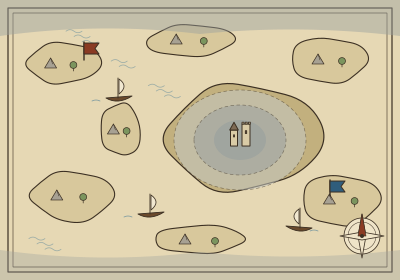
No one holds the Realm alone. Band together with lords you trust: allies cannot raid, occupy or scout one another, and an ally's pass is as free to cross as your own. The map is colored by alliance, so allied lands read as one, with the alliance tag before each name (you can switch back to coloring by lord in the alliance panel).

Allies share what they learn: talk to them in the alliance channel at the bottom left; intel scouted by any ally is seen by the whole alliance (the channel announces who was scouted, and the raid view's odds use it); allied marches and enemies marching on an ally show on your map, and you are warned when an ally comes under attack.

You can station troops in an ally's city: when raiders come, the host's army and every garrison fight as one, behind the host's walls and under the host's defending hero; losses are shared by how many troops each brought, and renown by the strength each lent. A city houses 50 garrison troops per town hall level; garrisons take no hero and still eat their owner's food, the owner can withdraw them at any time, the host can send them home, and they all go home if the two of you stop being allies.

Allies can also strike a city together: call a rally, pick an enemy capital and a strike time (1, 2, 4, 8, 12, 24, 36 hours ahead), and your allies send troops to wait beneath its walls. At the strike time everyone there fights as one army, under the leader's general and bonuses; losses are shared by how many troops each brought, loot by what each side's survivors can carry, and renown by the strength each lent, and then everyone marches home. Troops that join bring no general and must reach the walls before the strike; the leader can call it off and anyone who joined can withdraw.

Founding an alliance costs 500 Gold; the founder becomes its leader. Others apply in the alliance panel and the leader or an officer accepts them — or the alliance can be open to all. An alliance holds at most 10 members and 2 officers.

The leader cannot simply leave: hand over leadership or disband first. After leaving or being expelled you must wait 12 hours before joining or founding another alliance.

The Royal City

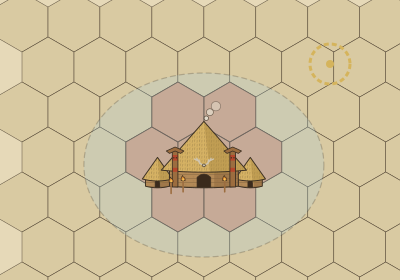
The Royal City at the heart of the Crownlands has stood empty for three hundred years. On day 21 the Crownlands open and the contest for the Royal City begins; it ends on day 35 — the last two weeks of this expansion.

The city's guards are too strong for any one house: only an alliance can take it, by calling a rally and striking together — raids and occupation will not do. The Royal City lies at the heart of the central continent, far from the outer lands, so marches on it (and garrisons sent into it) may go farther than usual; a rally can wait up to 36 hours, so distant allies can make it in time.

Once taken, the Royal City belongs to the alliance whose rally took it: its members can garrison the city (it holds 500 troops), and another alliance must rally in turn and wipe out the defenders to take it. There is nothing to plunder in the Royal City, and taking it raises no shield.

The moment day 35 arrives, the alliance holding the city is crowned: a crown before its tag, a monument in the Royal City, and its leader's name in the chronicle of the High Kings. The regency then lasts until the next expansion, and the city is not contested meanwhile; in that expansion's last two weeks another round begins, and the regent must hold the city.

Expansions

Each time the Grey Tide ebbs from another stretch of the world, a new expansion begins: new land rises, new ages wake, and the Royal City is contested again. The first expansion runs from the founding of the world, with the Stone Age, Bronze Age, Iron Age; on day 42 the southern tide ebbs and the second, The Southern Ebb, begins, revealing Ebbshore and opening the Medieval Age (day 42), Gunpowder Age (day 56).

Until an expansion begins, its land stays under the mist: you cannot see it on the map or march into it, and the southern mist tells you how long remains. The moment it begins, a notice appears on the page; click it to load the new map. The outer provinces of the new land open that same day; the province at its heart (Sunkenhold) opens 7 days later and has richer deposits.

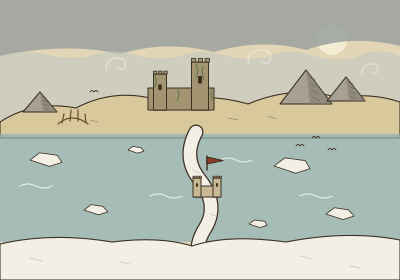
Once an expansion begins, newcomers found their cities on the new land only; the old outer provinces keep the covenant's protection but take no newcomers. Old lords may push into the new land too, by the usual rules: new land must touch your own, and armies can only cross by the isthmus fort that joins the two continents. Warlords and wild tribes arrive on the new land the moment it is revealed.

The Royal City is contested in the last two weeks of every expansion: days 21–35, days 63–77. If the throne stands empty when a round opens, its guards are restored in full; a regent alliance still holding it must defend it themselves.

Beyond the Tide

The Heartland's provinces open ring by ring as the Grey Tide recedes: the middle ring on day 7, the inner ring and the Crownlands on day 21. Provinces not yet open can be seen but not entered; on the map they lie under a veil of mist.

The grey mist churning at the far north and south of the map is the Grey Tide that has not yet ebbed. Beyond it lie lands not yet awake; through the mist you can just make out coasts no one has finished charting.

The Realm is never wiped away: your cities and your lands remain. With each expansion to come, the Grey Tide will pull back once more and reveal a new continent.

The Royal City at the heart of the Crownlands has stood empty for three hundred years: whoever holds it when a round of the contest ends is crowned (see “The Royal City”).

The throne is still empty

There is still plenty of open land in the Realm, waiting for your first city.

Play free now